
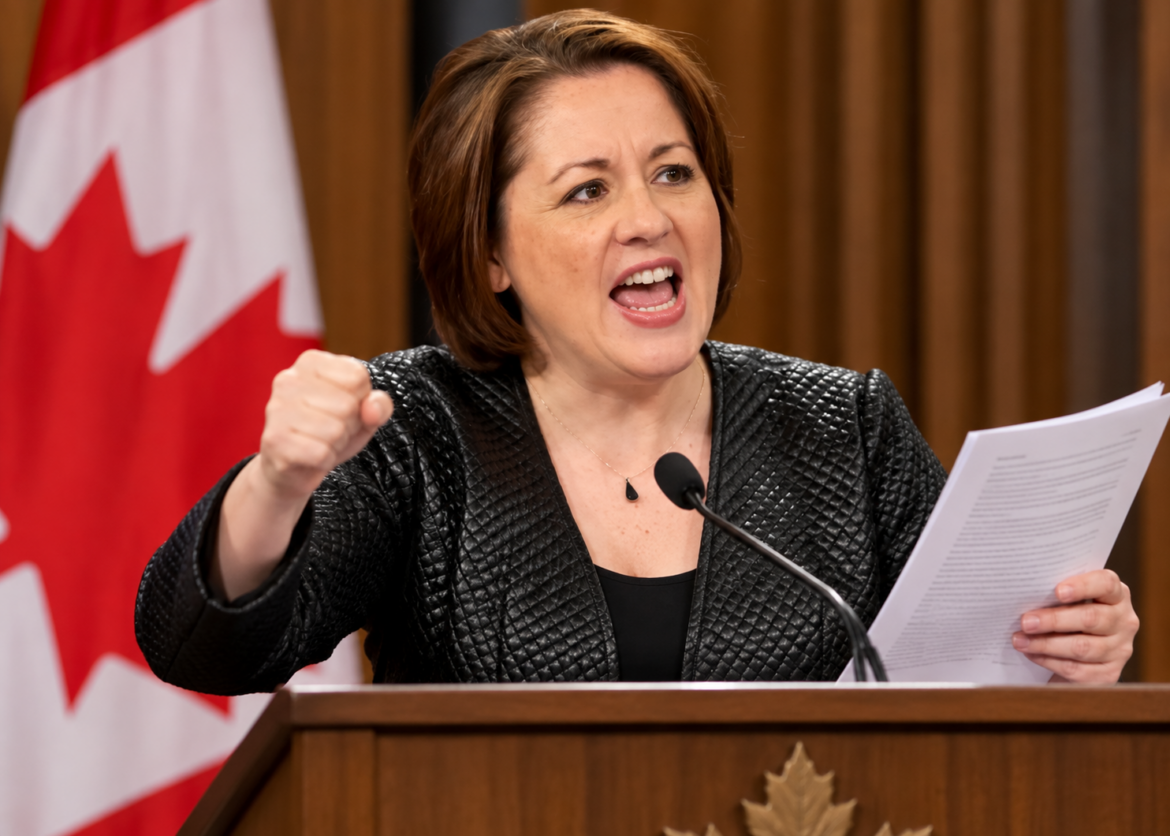
Rosemary Barton talked about her hopes for the future of journalism as the speaker for Carleton’s Dick, Ruth and Judy Bell Lecture, held on March 28.
A graduate of Carleton’s masters of journalism program, Barton is the current host of CBC’s Power & Politics television show.
The lecture is an annual event to honour people who have made contributions to political and public life in Canada, according to opening remarks made by Faculty of Public Affairs (FPA) dean André Plourde. The event was held as part of FPA Research Month.
“To have time to reflect on what I do and why it matters is a great thing,” Barton said at the beginning of her speech, titled “Why Journalism Matters (now more than ever before).”
She talked about her experience joining CBC’s Ottawa parliamentary bureau in 2007, and drew parallels between the sour relationship that existed between media and the previous Conservative government with the relationship American media is navigating with the current Trump administration.
“If you can’t talk to the government about how it’s doing its job, how do you do your job as a journalist?” Barton asked. “The answer is to find other ways. Ultimately, politicians are people, and they just want to be heard. People want to tell you things, and journalists prevail.”
Barton also discussed the increasing demand for journalists to be “inter-platform,” rather than specialize in a particular medium.
“You do anything, you do it all the time, you do as much as possible,” Barton said. “When you do it well, I would suggest you have greater impact. And when you’re under extreme stress, I would even suggest that you flourish.”
Speaking about why journalism matters to her, Barton said the job of a journalist is to do more than just listen.
“Journalism’s job is to work hard to make sure that all those people who don’t think they have a voice, or don’t know how to find people like me to give them a voice, are heard,” she said. “You can choose to see lots of discouraging signs for journalism, or you can do what I’m doing—you can believe that journalism is becoming more relevant, more resilient, and ultimately more welcome for people who are looking for answers in an increasingly complicated world.”
Barton took time to speak with The Charlatan following her lecture to discuss her interviewing style, and her advice for young journalists
The Charlatan (TC): With your job at Power & Politics, some people might say that you’re known for being an aggressive interviewer. How do you balance being aggressive with being objective?
Rosemary Barton (RB): I would say I’m not aggressive, I would say I’m tough. I think there’s a difference. And I would also say that I’m equally tough, and I think that’s my reputation. Politicians understand what their job is, and they understand what my job is, and they understand the dynamic between us. What a lot of people don’t know is after a very feisty interview or a very feisty panel, I will tease the politicians and say ‘oh yeah, I guess you did okay,’ and we will laugh, and off they go. Sometimes, not always. Sometimes an interview is really tense and it might take a couple weeks for the person to come back, but I would say generally that I’m equally tough. And as long as you’re equally tough, then you’re still objective.
TC: What changes have you noticed in the world of journalism since you graduated from journalism school?
RB: I think technology is probably the biggest change, which has improved the job, made the job easier, but also made the job way more demanding, and made it so that you have to get things out faster. I think the job remains the same—it’s about telling stories, it’s about listening to people, it’s about asking good questions. But everybody’s job has been affected by technology that is changing still.
TC: In your role at Power & Politics, who has been the most interesting or the most difficult person to interview?
RB: My favourite interviews are actually moments when I can talk to politicians about personal things, or things that matter to them and they are doing for personal reasons or motivations. I did an interview with a Liberal [Member of Parliament] about her depression, she came out and talked about how she had clinical depression and she was talking about it openly because she wanted people to know about it. You do interviews with people about decisions they’ve made in their personal lives or things that they care about that influence their policy decisions. When you can sort of humanize a politician, those are the moments that I like the most.
TC: What do you think that you want to do with a career as a journalist?
RB: Be Oprah? [laughs] I don’t know, I actually have not planned out my career. I think that if you work hard, a little bit of luck, right place, right time, you are presented with opportunities and you can take them or not. I would be okay doing this [Power & Politics] for a lot longer, until I’m not. I like my job a lot, so I’m okay with where I am now.
TC: What do you see as the future of journalism?
RB: It is technology that is going to sort of guide us in a particular direction. I’m sure everybody knows there are fewer people watching TV. I may not have a TV show in 10 years because nobody’s watching TV, or TV doesn’t look like this anymore. So we need to figure out ways to push content onto platforms where people are going to be able to get it, whether it’s TV or YouTube or online or whatever is invented in 10 years, things we can’t even imagine. But again, I just go back to that same point that the job itself doesn’t really change. People have wanted and told stories for thousands of years, and that’s still going to happen.
TC: What advice would you give to young aspiring journalists?
RB: The first piece of advice that I give to everybody is go wherever there is a job, even if it’s not somewhere you want to live. It’s just for the beginning of your life, it’s not your whole life. I lived in a room in a house in Quebec City, I rented a room, it was a really grubby house. I didn’t have a TV in my room, it was a little tiny bed, it was not very fun. It did not last. I’m okay now. So you have to do those things that scare you a bit, and you have to be willing to move around a little bit too, to do different jobs, to try different things. Be brave.