

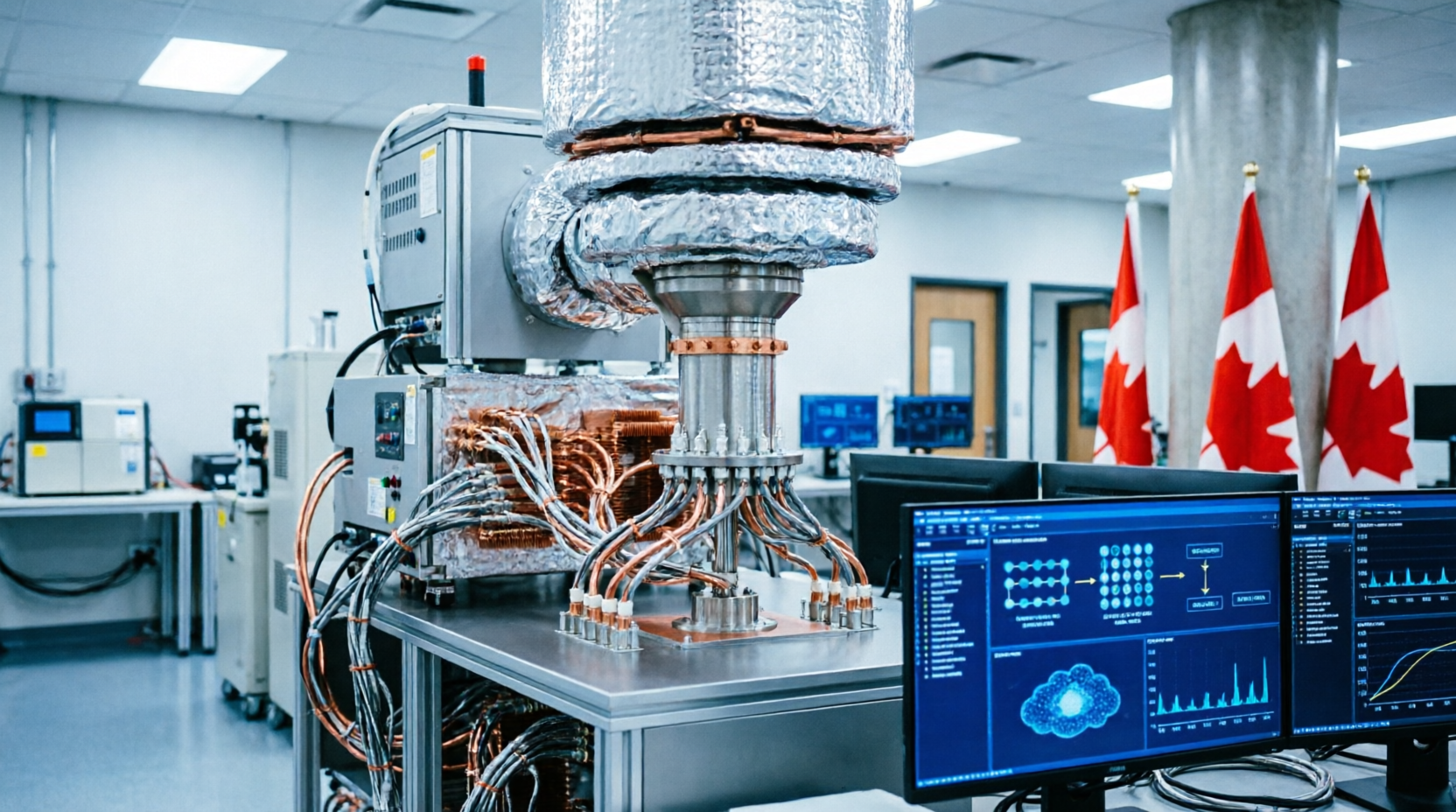
The University of Waterloo, long recognized as Canada’s technology and innovation powerhouse, has achieved a monumental breakthrough in quantum computing that is sending shockwaves through the global tech industry. Researchers at the Institute for Quantum Computing (IQC) have successfully demonstrated a novel method for significantly extending qubit coherence times while drastically reducing error rates. This advancement, published in a leading peer-reviewed journal, addresses one of the most fundamental hurdles in quantum computing, moving the technology closer to practical, large-scale commercial applications and sparking intense interest from global tech giants and venture capitalists.
Advertisement
Quantum computers leverage the principles of quantum mechanics to process information at speeds exponentially faster than classical supercomputers. However, qubits—the fundamental units of quantum information—are notoriously fragile. Environmental noise, such as temperature fluctuations or electromagnetic interference, causes them to lose their quantum state, a phenomenon known as decoherence, which introduces errors into calculations. The Waterloo team’s breakthrough involves a new type of topological qubit architecture combined with advanced machine learning algorithms for real-time error correction. This hybrid approach has allowed the researchers to maintain stable quantum states for unprecedented durations, paving the way for more complex and reliable quantum computations.
The commercial implications of this breakthrough are vast. Industries ranging from pharmaceuticals and materials science to finance and logistics are eager to harness quantum computing to solve problems that are currently intractable for classical computers. For instance, in drug discovery, quantum simulations could accurately model molecular interactions, reducing the time and cost of developing new medications from a decade to a matter of months. In the financial sector, quantum algorithms could optimize massive portfolios and detect fraudulent transactions with unparalleled precision. Recognizing this potential, several major multinational corporations have already initiated partnerships with the University of Waterloo to co-develop commercial applications based on this new technology.